
Businesses from across Birmingham and the Midlands have come together to support parents and carers return to STEM jobs.
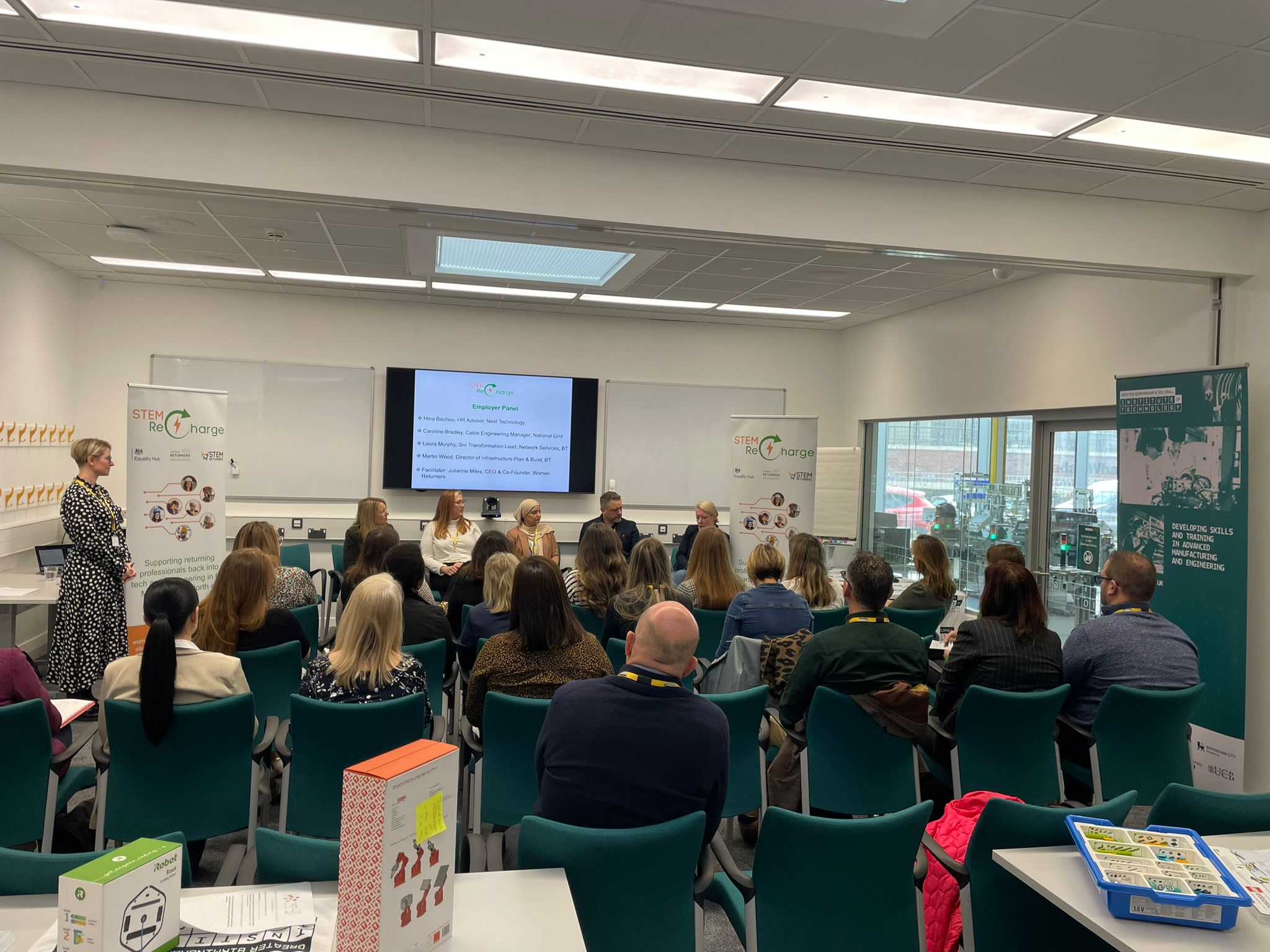
Local employers and representatives from STEM industry groups attended the STEM ReCharge Employer Insight Event at the Greater Birmingham and Solihull Institute of Technology to gain insight into how they can access the untapped talent pool of STEM professionals on career break and enable more tech and engineering professionals back to work.
The event was organised by Women Returners and STEM Returners, two leading organisations in the UK in STEM returner programmes, as part of the STEM ReCharge project funded by the Government Equality Hub. The event was supported by West Midlands Combined Authority (WMCA).
At the event, local STEM employers, BT, Next Technology and National Grid, shared their experiences of successfully hiring and supporting returners and talked about the benefits to their organisations. Julianne Miles, CEO and Co-Founder of Women Returners and Anouska Carling, EDI Lead at STEM Returners also shared their expertise, having enabled more than 700 professionals to return to the sector.
Clare Hatton, Director of Employment & Skills at WMCA, said: “We are proud to support this event to highlight the importance of parents and carers being given a suitable avenue back into the workplace.
“There can be an unfair stigma around those who have taken a break from their careers to raise, care for or support their family. But modern and forward businesses should instead be thinking about how best to tap into the impressive pool of talent in the region that is looking to return to work in STEM and use it to their advantage.”
The STEM ReCharge team have also hosted events this week in Liverpool and Birmingham. A virtual Insight Event will be held in early June for employers in the North of England and the Midlands who were unable to attend in-person.
Free online Career Returners Recruitment and Inclusion Training will be held in the summer, for which registration is open now, followed by ongoing support for employers until mid-2024.
STEM ReCharge, funded by the Government Equality Hub, is being rolled out across the Midlands and North of England after analysis carried out by Women Returners and STEM Returners showed these areas have far fewer returner programmes than southern areas. From 2020 to 2022 there were 1.6 returner programmes per million people in the Midlands, 2.3 programmes in the North East and Yorkshire and 2.5 programmes in the North West, compared with 7.8 programmes in London and 5.3 programmes in the South West.
There are currently around 75,000 people (the majority women) who are economically inactive due to caring responsibilities in the UK, who had a STEM occupation before their career break and who would like to return to work in the future, according to government figures. Additionally, many more professionals are working well below their skills levels around their family. These talented professionals face an uphill battle when trying to get back to professional work, with a range of challenges from lack of self-confidence to widespread recruiter bias against people with a gap on their CV.
As well as supporting businesses, STEM ReCharge will provide return to work career coaching, job skills training and sector-specific upskilling and mentoring to 100 individuals with tech or engineering experience based in the North and the Midlands. The Spring cohort is already full and applications will open in July for the Autumn cohort.
Julianne Miles, CEO of Women Returners, said: “We were delighted to see so many businesses from across Leeds and Yorkshire come to the event and engage with us. Over the last 9 years, I have seen the multiple challenges parents and carers face when trying to return to professional roles after a long career break. Working together with local employers, we would like to multiply the supported routes back to STEM roles for all career returners in the region.”
Natalie Desty, Director of STEM Returners, added: “We’d like to thank everyone who participated in the event. More conversations are needed to enhance working practices, so people are not penalised for their career break. By partnering with industry and Government will can make vital changes in STEM recruitment practices, to help those who are finding it challenging to return to the sector.”